Education Terminology

Do you sometimes hear words used by staff at school, but wonder what they really mean?

This list explains the meaning of common academic words and acronyms that you may hear used by teachers, to describe teaching and learning.
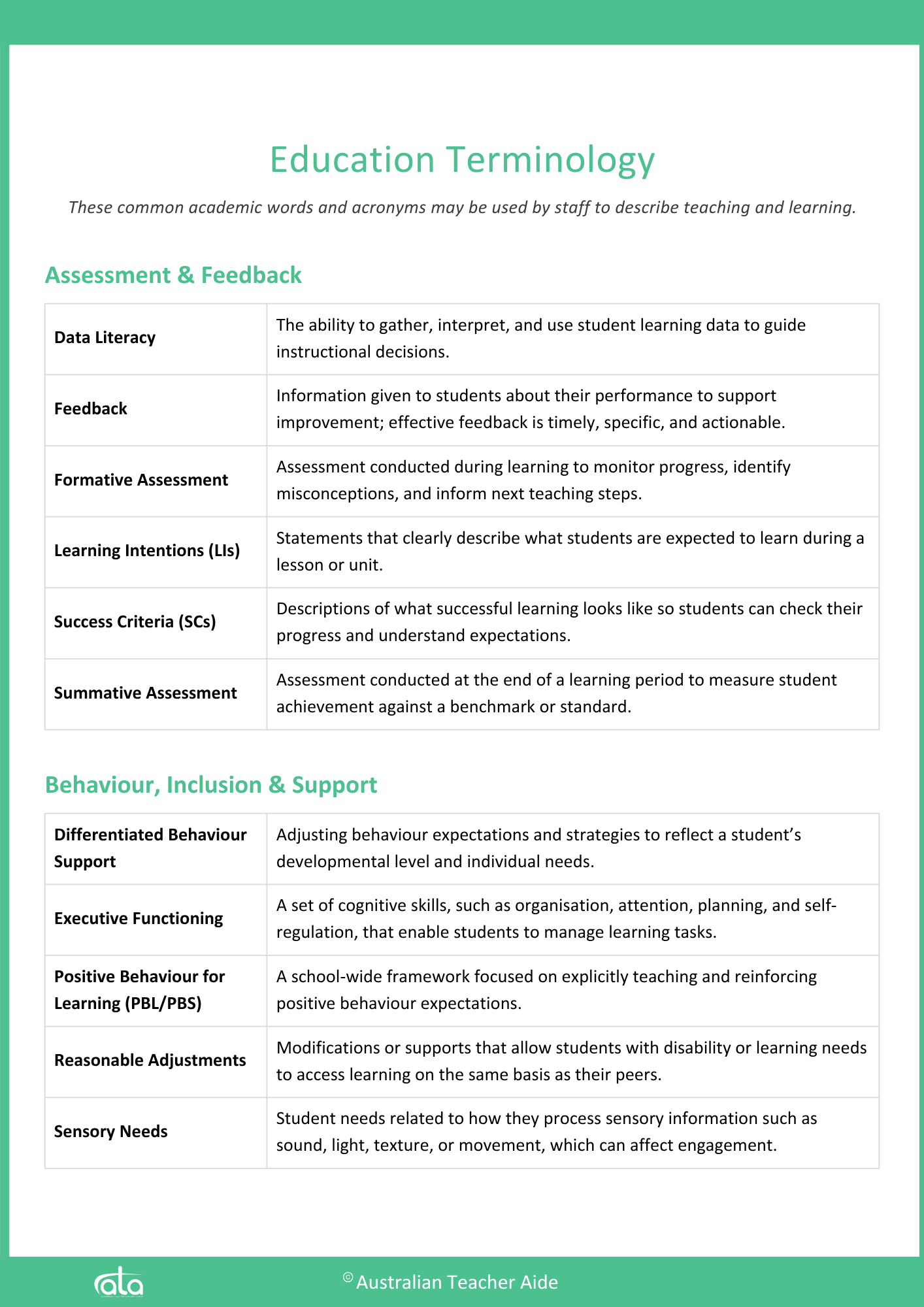

Download the Education Terminology


Assessment & Feedback

Data Literacy: The ability to gather, interpret, and use student learning data to guide instructional decisions.

Feedback: Information given to students about their performance to support improvement; effective feedback is timely, specific, and actionable.

Formative Assessment: Assessment conducted during learning to monitor progress, identify misconceptions, and inform next teaching steps.

Learning Intentions (LIs): Statements that clearly describe what students are expected to learn during a lesson or unit.

Success Criteria (SCs): Descriptions of what successful learning looks like so students can check their progress and understand expectations.

Summative Assessment: Assessment conducted at the end of a learning period to measure student achievement against a benchmark or standard.


Behaviour, Inclusion & Support

Differentiated Behaviour Support: Adjusting behaviour expectations and strategies to reflect a student’s developmental level and individual needs.

Executive Functioning: A set of cognitive skills—such as organisation, attention, planning, and self-regulation—that enable students to manage learning tasks.

Positive Behaviour for Learning (PBL/PBS): A school-wide framework focused on explicitly teaching and reinforcing positive behaviour expectations.

Reasonable Adjustments: Modifications or supports that allow students with disability or learning needs to access learning on the same basis as their peers.

Sensory Needs: Student needs related to how they process sensory information such as sound, light, texture, or movement, which can affect engagement.


Curriculum & Planning Terms

Curriculum Alignment: Ensuring that learning activities, teaching strategies, and assessments align with curriculum expectations and learning goals.

Differentiation: Adjusting instruction, tasks, and supports to meet the diverse learning needs of students.

Gradual Release of Responsibility (GRR): A teaching model moving from I Do (teacher modelling), to We Do (guided practice), to You Do (independent practice).

Individual Education Plan (IEP): A personalised plan outlining goals, adjustments, and supports for students with disability or additional learning needs.

Individual Learning Plan (ILP): A targeted plan outlining strategies and goals for students needing additional academic support, not always disability-related.

NAPLAN: National Assessment Program Literacy and Numeracy, conducted in Years 3, 5, 7, and 9 in Australia.

Universal Design for Learning (UDL): An instructional approach that designs lessons to provide multiple ways for students to access content, engage, and show learning.


Learning Processes & Cognitive Terms

Cognitive: Relating to mental processes such as memory, reasoning, comprehension, and problem solving.

Metalanguage: Language used to describe features of language itself, such as noun, verb, clause, tense, or adjective.

Metacognition: “Thinking about thinking”- the ability to plan, monitor, and evaluate how one learns or solves problems.


Questioning Techniques

Closed Questions: Questions that require short or one-word responses (e.g. yes/no), typically used to confirm understanding.

Open Questions: Questions that require explanation and deeper thinking, often beginning with how, why, or what.

Probing Questions: Follow-up questions used to deepen or clarify a student’s understanding or encourage more detailed responses.


Roles & Professional Language

Duty of Care: A legal and ethical responsibility to ensure the safety, wellbeing, and protection of students by taking reasonable precautions.

Professional Development (PD) or Professional Learning (PL): Ongoing reflection and development undertaken by educators, individually and collaboratively, to improve student outcomes.


Teaching & Learning Frameworks

The Art and Science of Teaching (ASOT): A pedagogical framework developed by Robert Marzano that guides educators in planning, delivering, and reflecting on effective instruction.

Collaborative Learning: Learning that occurs when students work together to solve problems, share ideas, and build understanding.

Explicit Instruction: A structured teaching approach using clear modelling, guided practice, and feedback until students can perform skills independently.

Habits of the Mind: A set of 16 thinking dispositions developed by Art Costa that help learners become effective, flexible problem solvers.

Multiple Intelligences: Howard Gardner’s model proposing that students learn and demonstrate understanding in different ways, such as linguistic, logical, visual–spatial, and kinaesthetic.

Pedagogy: The theory and practice of teaching and learning. A pedagogical framework outlines the consistent teaching practices used across a school.

Scaffolding: A temporary support structure that helps students learn new skills, gradually removed as they gain independence.


Various School Acronyms & Terms for TAs

English as an Additional Language or Dialect (EALD): Used to describe learners who speak a language other than English at home and are developing proficiency in English.

English as a Second Language (ESL): A traditional term for students learning English in addition to their first language.

Languages Other Than English (LOTE): Refers to language subjects taught in schools, such as Japanese, French, or Indonesian.

Occupational Therapist (OT): A specialist supporting student participation through development of fine motor, sensory, and functional skills.

Response to Intervention (RTI): A tiered model of support that identifies students needing academic or behavioural intervention and provides structured support.

Special Educational Needs / Special Educational Needs & Disabilities (SEN / SEND): Refers to students who require additional support due to disability, learning difficulties, or developmental challenges.

Speech–Language Pathologist / Speech Pathologist (SLP / SP): A specialist who supports students with communication, language, speech, and literacy needs.

Technical and Further Education (TAFE): Provides vocational education and training options, often linked to school pathways or senior secondary programs.


Contact us with a term or acronym that you would like to see in this list.